

What makes Ceremonial Cacao Different?


What’s the Difference?
Many people ask about the difference between ceremonial cacao and raw cacao, or how
cacao compares to cocoa and hot chocolate. While cacao is often used as a catch-all term, not all cacao products are the same.
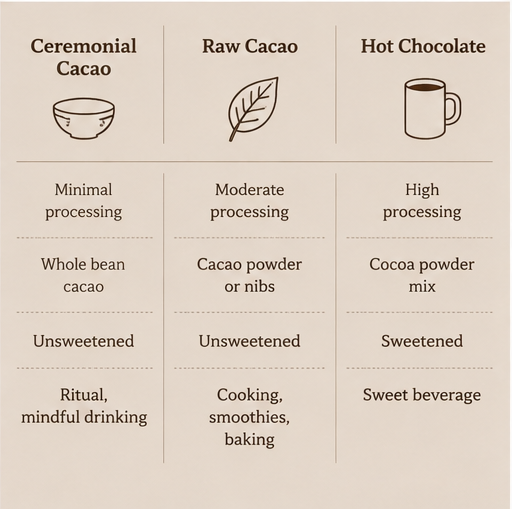
Ceremonial cacao, raw cacao, and hot chocolate differ significantly in processing, purpose, and how they are typically consumed.
Ceremonial cacao differs from raw cacao because it retains the full cacao butter and is typically consumed as a drink, while raw cacao is often processed into powder and used as an ingredient.
Understanding these differences helps you choose the form of cacao that best fits your intention — whether for nourishment, ritual, or simple enjoyment.

What Is Ceremonial Cacao?

Ceremonial cacao is made from whole cacao beans that are minimally processed. The beans are fermented, dried, lightly roasted, and ground into a solid cacao mass or paste.
Key characteristics of ceremonial cacao:
made from whole cacao beans
minimally processed
unsweetened
no additives or fillers
traditionally consumed as a drink
Ceremonial cacao is valued not for sweetness, but for presence, warmth, and attentiveness. It is often prepared slowly and
consumed mindfully.
What Is Raw Cacao?
Raw cacao usually refers to cacao powder made from cacao beans that have been cold-processed or minimally heated.
Raw cacao products commonly include:
raw cacao powder
raw cacao nibs
These are typically:
pressed to remove cacao butter
ground into powder
used in smoothies, desserts, or baking
Raw cacao is often chosen for its nutritional profile and versatility in recipes. It is primarily treated as an ingredient, not a ritual beverage.
What Is Hot Chocolate?
Hot chocolate is a processed, sweetened drink made from cocoa powder.

Cocoa powder differs from cacao because it:
is heavily processed
has most of the cacao butter removed
is often alkalized (Dutch-processed)
Hot chocolate mixes commonly contain:
sugar
milk powder
flavorings
stabilizers
Hot chocolate is designed for comfort and sweetness, not mindful preparation or ritual use.
Processing: The Key Difference
The main distinction between ceremonial cacao, raw cacao, and hot chocolate lies in how the cacao bean is processed.
Type | Processing Level | Typical Use |
Ceremonial cacao | Minimal | Ritual, mindful drinking |
Raw cacao | Moderate | Cooking, smoothies, baking |
Hot chocolate | High | Sweet beverage |
The more processed the cacao, the further it moves away from its original form.
Intention Matters More Than Labels
While these categories are helpful, intention plays a central role.
Ceremonial cacao is not defined by branding or certification alone.
It is defined by:
quality of the beans
minimal processing
unsweetened preparation
the way it is prepared and consumed
Raw cacao and hot chocolate can be enjoyed fully — they simply serve different purposes.
Which One Should You Choose?
Choose ceremonial cacao if you:
enjoy slow, intentional preparation
value presence over sweetness
want cacao as a ritual companion
Choose raw cacao if you:
cook or bake with cacao
prefer flexibility in recipes
focus on nutritional use
Choose hot chocolate if you:
want a sweet, comforting drink
prefer convenience
enjoy cacao casually
None is better — they are simply different.
Closing Reflection
Cacao does not need to be elevated to be meaningful. Nor does it need to be simplified to be enjoyed.
Understanding the differences allows you to choose cacao with clarity — and to meet it exactly as it is.
Sometimes awareness alone is the most valuable ingredient.
— Miriam
Founder, with Art & Soul
